The Family Estate Prestin
Prestin was during the time of the Wends a circular wooden fort surrounded by a moat. In the later Middle Ages, after the Wends were Christanised, times remained unsafe and the fort was needed because of raids by the Danes and Swedes. In 1270 Petus v. Pressentin replaced the wooden fort and church by stone constructions.
In 1538 Dinnies v. Pressentin built the first Manor House on what was the stone fort. This was a single story building, with the bible text "the word of the lord is eternal" over the front door. In 1728 Johann Wilhelm I v. Pressentin extended the house and added a second story. Sometime after 1766 the moat was filled in on three sides and the walls of the building were plastered and given an block pattern. In 1808 Johann Wilhelm v. Pressentin constructed a private family chapel next to the church.
Adolph v. Pressentin reported in 1864 that he had seen the remains of the drawbridge and the foundations of the gatehouse. In 1886 Karl and Bernhard v. Pressentin reported that the former moat was clearly recongnisable and the thick walls of the huge cellars were those of the former walls of the fort.

The Estate in Prestin 1766
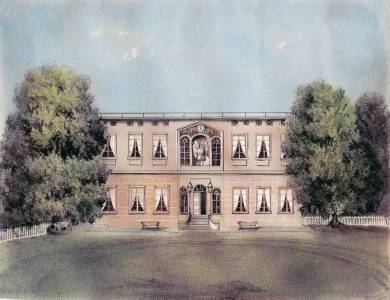
The Manor House in Prestin 1857
A map from the family archives details the estate in Prestin as it was in 1766 with the manor house, the former moat, the parkland and gardens and the church. The drawing dated 1857 by Louise v. Pressentin shows the house not long before the death of her father Adolph v. Pressentin in 1864. It was after his death that 1872 his six sons, who had their own estates, sold Prestin to an industrialist Johann Christian Thormann and so ended 602 years of continued recorded ownership of Prestin by the v. Pressentin family. The manor house was not greatly changed by the Thormans or any of its subsequent owners. At the end of the war the house was burnt to the ground and a bungalow now stands on the site.
The heart of the family remained in Prestin in the form of its private family chapel, indeed when the estate was sold the family specifically excluded their private chapel. The family continued to gathered regularly here until the outbreak of the war. An interregnum enforced by the communist German Democratic Republic followed. In 1998 the family once again gathered for prayers in the family chapel.